
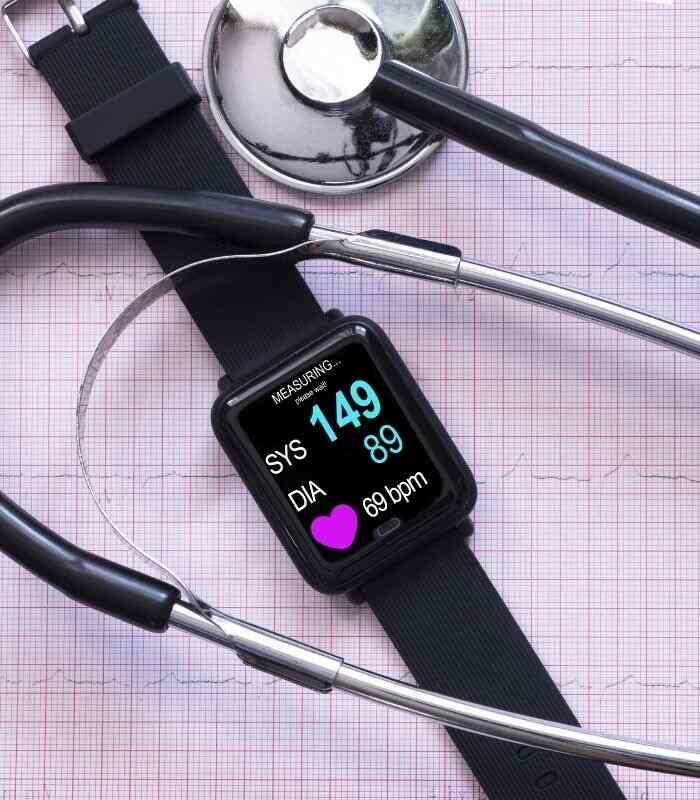
We have learned that smartwatches can act as your health tracker or monitor. But people are not satisfied with just knowing that smartwatches can measure blood pressure, they also want to know how the technology works behind the scenes.
We, too, wish to know if it is just for show or it does work the best. That is why we did a little research with some of the most popular blood pressure measuring smartwatches. Now, we share the technology with you.
The process measures blood pressure:
There are two particular sensors in smartwatches. The first sensor is the Pulse Transit Time technology, in short PTT. PTT, on the other hand, uses two other sensors. They are: electrocardiogram and optical heart rate. Smartwatches measure the PTT or pulse transit time with these two sensors. Pulse transit time refers to the time a heart pulse needs to travel to and from the wrist.
When the pressure of blood is very high then the PTT will be lower because a pulse will travel faster, and if the blood pressure is lower then the PTT will be higher. A calibration with a BP monitor is needed to find out the correct blood pressure value. Every person has a different physiology, and therefore, the BP value will also be different. Hence, a calibration is needed for each individual.
You can start the blood pressure measurement process by placing your finger on the electrocardiogram sensor. Each R-peak sharp spike refers to one contraction of your heart, and this is the moment when your heart pulse leaves your heart.
There is this PPG sensor or Photoplethysmograph sensor of your watch. This PPG sensor is a very simplistic way to monitor your heart rate. This technology is non-invasive and uses a photodetector and a light source on the surface level of your skin and measures the blood circulation’s volumetric variation. These two reside on the backside of your smartwatch. The pulse that starts from the heart creates a pulse wave, and the PPG sensor detects it.
Now, the time difference between the heart pulse that ECG picks up in the form of R-peak and the pulse wave read by PPG, is measured in the form of PTT. This is how a smartwatch measures your blood pressure.


![How to Change Time on Fossil Smart Watch [A GUIDE]](https://techdenbd.com/backend/img/blog/how-to-change-time-on-fossil-smartwatch-2022-06-29-62bbdf51aaea7.jpg)